Product Range: Silent Running Audio
Taalam
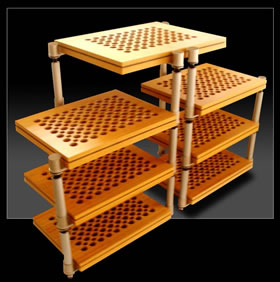
Rethm has also introduced a new component stand called Taalam -- which in Indian music is the timing or beat -- to focus its future sales efforts on two speaker models and one stand. The dense perforation patterns of the multi-layer shelves not only break up standard plate modes, they double as acoustic diffusers for sonic floor reflections. Very clever.
The third reason for the thru holes is that I wanted the rigidity that comes from 50mm wood slabs but I did not need the weight. So the holes were machined in to give me a wooden honeycomb for the shelves which are immensely rigid yet very light. And that's just part of the story on the rack. There are several layers of isolation. You will notice the line on the side of the shelves. That is a 6mm layer of polyurethane foam between an 18mm ply above and a 27mm ply below all bonded together. That's the first level of isolation. Then with the short arm that comes out of the shelf and slides into the vertical legs, there are several forms of isolation/vectors of flexibility. The arm itself ends in a 50mm high sleeve which slides onto the vertical bearing member. The inside of the sleeve is lined with 2mm thick polyfoam again so that rigid metal does not contact rigid metal. There is deliberate play there. In the vertical direction, this arm/sleeve combination actually sits on a neoprene ring which is the interface between the arm and the bearing surface on the vertical leg.
Next, each shelf is completely separate. You can actually buy these shelves as and when you need them and just put them on top of the previous ones. So there is no single frame that links all of them together. And the interface between the legs of each shelf is a low-elasticity ( i.e. it will not really bounce if you dropped one of these on the floor ) neoprene ball sitting inside cupped surfaces top and bottom. So in effect, each shelf can move in all directions if you push it. Despite being the designer, even I was a little unsure if the whole system would be stable under load as it has no rigidity as a unit whatsoever. But we tested it and it is perfect. The orientation of the shelves is also modular. You can use the shelves sideways (as shown in the photograph) or you can orient the shelves turned - and you can use both configurations within the same stack. There are bolt inserts put in below to enable the arms to be attached either way. The arm lengths are varying to allow this to happen. So when we sell a customer a shelf, it comes with 4 arms instead of just 3 so that it can be fitted any which way.
Lastly, each shelf system also comes with 3 dished wooden pucks about 50mm in diameter -- with glass balls not shown in the photograph -- to be placed on the shelf to support the equipment you will have on it. This was done essentially because I realized that as a result of the rather close hole pattern on the surface, equipment may not sit perfectly on the shelf if the placement has the holes at some critical points aligning with the footers on the equipment itself.